Keeping that connection useful through a busy working day involves spacecraft, gateways, terminals and a support organisation. Orbit height explains only part of the story.
Altitude is an engineering trade-off
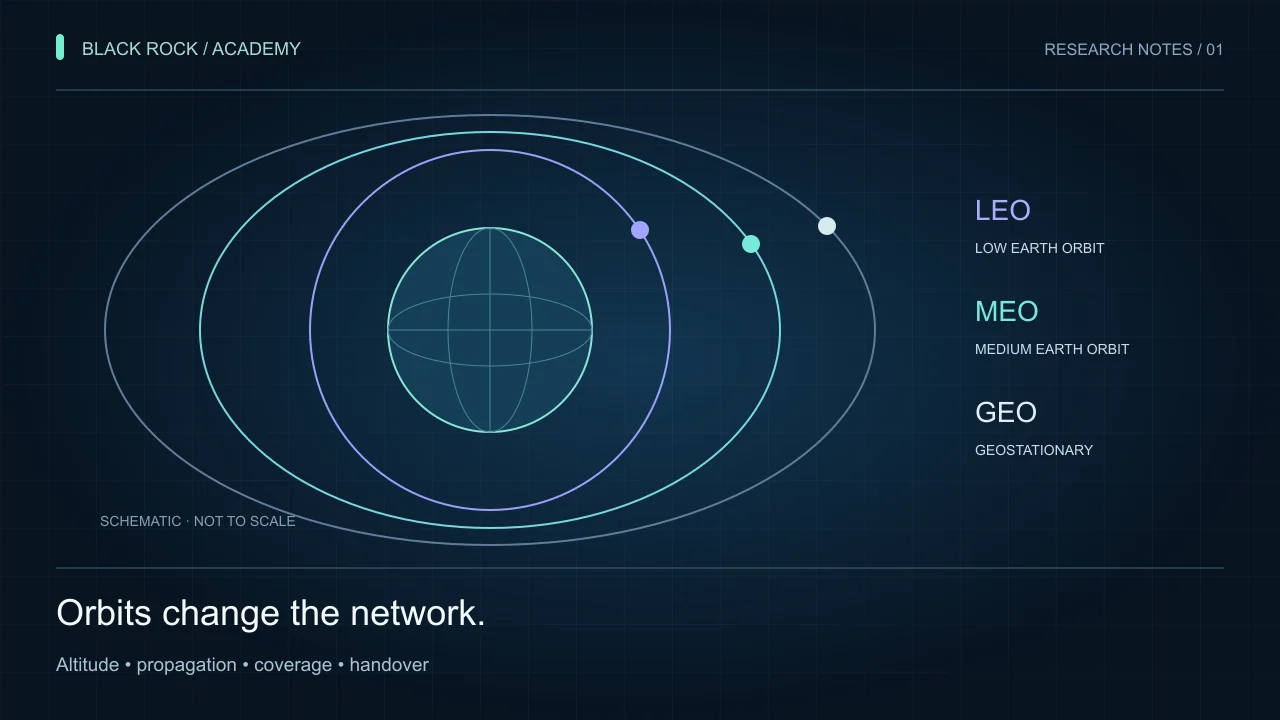
A satellite's orbit determines its coverage footprint, motion across the sky and propagation delay. LEO generally means altitudes below 2,000 km; MEO lies between LEO and geostationary altitude. A geostationary satellite follows a circular equatorial orbit at approximately 35,786 km and appears fixed above Earth. Polar and Sun-synchronous describe other orbital characteristics, not extra altitude bands. Highly elliptical orbits trade uniform coverage for long dwell time near apogee. [1]
Lower satellites cover smaller areas and move rapidly relative to a terminal. Continuous broadband therefore needs many spacecraft, handovers and coordinated routing. Higher orbits offer broader footprints with fewer satellites, but longer paths. Mission requirements also include inclination, spectrum, terminal antenna gain, power, gateway placement and debris mitigation; altitude alone cannot rank two services.
What physics says about latency
Consider a deliberately simplified user–satellite–gateway path and its return, with both ground endpoints almost directly below the satellite. Its space-path round-trip lower bound is approximately 4h/c, with c = 299,792 km/s. At 550 km this is 7.3 ms; at 1,200 km, 16.0 ms; at 35,786 km, 477.5 ms. These are calculations, not measured Starlink or OneWeb ping times.
Real links are slanted. Radio scheduling, queues, processing, terrestrial routes and the destination server add delay. Inter-satellite optical links can reach distant gateways, but do not guarantee the shortest route for every destination. Starlink's engineering account separates these latency components; its historical measurements must not be mistaken for a current local service guarantee. [2]
The innovation is the complete system
LEO communications existed before Starlink. Its distinctive approach combines large-scale spacecraft production, frequent launches, electronically steered user terminals, software-controlled handovers and a continuously operated ground network. The useful result is a service that can be deployed without building a new cable to each remote customer. Optical links extend routing options. [2][3]
There are limits: users share radio capacity; obstructions and weather can affect links; terminals need power; service requires local authorization and a suitable plan. A dish connected to broadband is also a different link-budget problem from direct-to-phone satellite messaging. Neither should be advertised as equivalent to the other.
Who else is competing?
The table is a status snapshot reviewed on 8 October 2026, not a promise of availability at an address. Eutelsat OneWeb already serves a different, strongly enterprise-oriented market. Amazon Leo, formerly Project Kuiper, is deploying its network. Telesat's stated start date is a forward-looking company plan. IRIS² is a European programme, not an already universal retail alternative. SES demonstrates that MEO also remains commercially relevant. [4][5][6][7][8]
| Network | Orbit / status | What to verify |
|---|---|---|
| Starlink | LEO · operating broadband | Address eligibility, plan and busy-hour capacity |
| Eutelsat OneWeb | LEO · operating network | Partner, terminal and enterprise service terms |
| Amazon Leo | LEO · deployment under way | Commercial readiness and country coverage |
| Telesat Lightspeed | LEO · planned; operator targets Q1 2028 service | Schedule, contracted capacity and availability |
| IRIS² | Planned European multi-orbit system | Programme milestones and service eligibility |
| SES O3b mPOWER | MEO · operating services | Managed-service design and contracted performance |
Choose by the application
For a vessel, remote worksite or disaster-recovery link, deployment speed and geographic reach may matter more than maximum throughput. For a dense industrial campus, sustained upload and predictable busy-hour performance may dominate. Request a site survey, a representative pilot, failover tests and contractual support terms. Compare delivered application performance, not the number of satellites in a press release. This is an engineering review; it reports no original field measurements.
Sources
ADNET / Resilience & hybrid connectivity
A decision for regional networks
In a regional connectivity project, satellite deserves a place in the same design conversation as power, fibre access and recovery time. A site trial should establish which applications it can sustain when the primary connection is unavailable.
Explore solution ↗Adapted for ADNET from the author's Black Rock Academy essay. Original technical discussion and references are retained; the ADNET application note below adds the corridor-planning context.
Read the original essay ↗Share or cite this article
Hamid Reza Assariha. LEO, MEO and GEO: why Starlink changed satellite broadband. ADNET, 2026-10-09. https://www.adnetinternet.com/insights/satellite-orbits-starlink-leo-meo-geo/