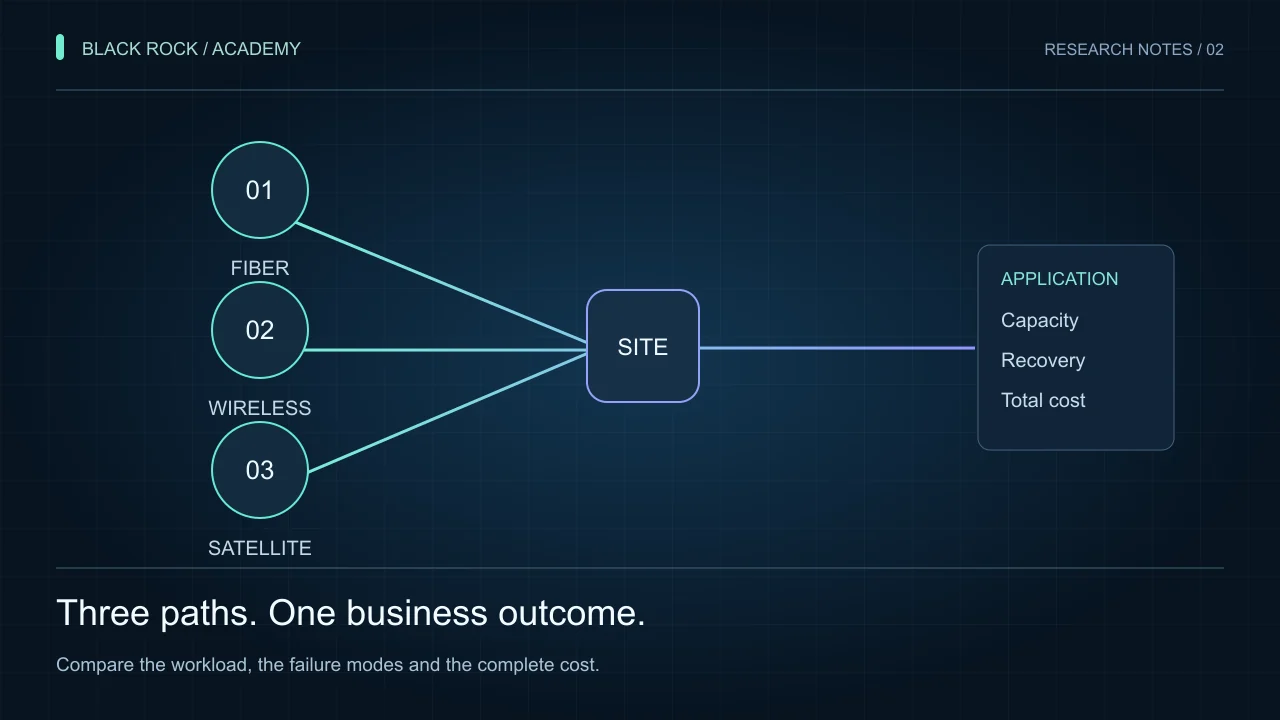
Distance, demand and the cost of interruption change the decision. A fair comparison begins with the work people need to finish each day.
There is no location-independent winner
A service can be excellent for a farm and unsuitable as the sole connection for a busy data centre. Start with simultaneous users, sustained upload, application latency, acceptable downtime and installation constraints. A low monthly price is meaningful only alongside terminal cost, data policy, congestion and the local alternatives. Prices and availability vary by country and address; this article deliberately gives no universal Starlink tariff.
Satellite, fiber and fixed wireless all depend on an end-to-end network. A fast access link cannot repair a congested upstream route, a poor Wi-Fi installation or an overloaded application server. Measure the complete path at representative hours, with comparable devices and destinations, before attributing a difference to the access technology.
Capacity is shared in different places
Fiber supports high aggregate capacity and upgrades through optical equipment, additional wavelengths and additional fibers. An access standard is not a per-customer throughput promise: XGS-PON is a 10-Gbit/s symmetric system shared according to the operator's design and subscriptions. [1] Dense demand can justify fiber's civil works; a distant isolated site may not.
LEO capacity is shared across radio resources and visible spacecraft. Terrestrial wireless shares sector spectrum and backhaul, with performance affected by geometry and interference. As a hypothetical illustration, 2 Gbit/s divided equally among 100 simultaneous flows is 20 Mbit/s per flow before overhead. This is arithmetic, not a claim about any operator's cell capacity. Spatial reuse, scheduling and traffic diversity change the outcome.
Compare ownership cost, not just the bill
Use TCO = equipment + installation + monthly fee × months + energy + maintenance + expected disruption cost. In an invented 36-month example, satellite costs 600 + 150 + 75×36 = 3,450 units; fiber costs 150 + 35×36 = 1,410; fixed wireless costs 250 + 50×36 = 2,050. These are arbitrary accounting units, not quotations. Taxes, energy and outage costs are excluded from these example totals.
A long trench, a tower lease or specialist installation can reverse that ordering. Equally, a cheap backup may pay for itself during one significant outage. Estimate disruption from the organization's own operations; do not assign a universal monetary value to downtime. Record assumptions so the comparison can be recalculated when real quotations arrive.
Hybrid connectivity creates useful opportunities
A fiber primary path with satellite backup can reduce dependence on one physical access route. Independence must be checked: both may share power, a router, DNS or an upstream facility. Test failover under an actual link interruption, including VPN recovery and application sessions. Policy routing can reserve backup capacity for essential traffic instead of carrying every software update.
Local operators can compete through reliable installation, managed Wi-Fi, industrial segmentation, security, edge services and support. Approved satellite integration can become one component of that offer. Selling a resilient application outcome is more defensible than competing solely on an advertised peak download rate. This is a proposed service strategy, not a claim that BLACK ROCK has an operator partnership.
| Access | Strong fit | Constraint to test |
|---|---|---|
| Fiber | Dense sites, sustained traffic, scalable capacity | Build cost, path diversity and shared access design |
| Fixed wireless | Rapid local deployment, difficult last-mile construction | Line of sight where required, spectrum and backhaul |
| LEO satellite | Remote sites, mobility where supported, diverse backup | Sky visibility, shared capacity, power and plan eligibility |
| Hybrid | Business continuity with application priorities | Common failure points and real failover behaviour |
A practical acceptance test
Run a multi-day pilot covering busy periods. Record download and upload distributions, packet loss, jitter, 95th-percentile round-trip delay and interruption duration. Check public-address needs, CGNAT, VPN compatibility, data allowances, support response and any SLA exclusions. Starlink's own latency analysis illustrates why queues and ground routing matter alongside orbit height. [2] Select the combination that meets the workload and recovery target at an acceptable lifecycle cost; this article contains no comparative field trial.
Sources
ADNET / Resilience & hybrid connectivity
A decision for regional networks
A hybrid offer needs one clear operating plan: which traffic survives a failure, how users are informed and who owns the incident. That service design is an opportunity for regional operators to add lasting value.
Explore solution ↗Adapted for ADNET from the author's Black Rock Academy essay. Original technical discussion and references are retained; the ADNET application note below adds the corridor-planning context.
Read the original essay ↗Share or cite this article
Hamid Reza Assariha. After Starlink: is there still a future for fiber and fixed wireless?. ADNET, 2026-10-09. https://www.adnetinternet.com/insights/starlink-fiber-fixed-wireless-comparison/