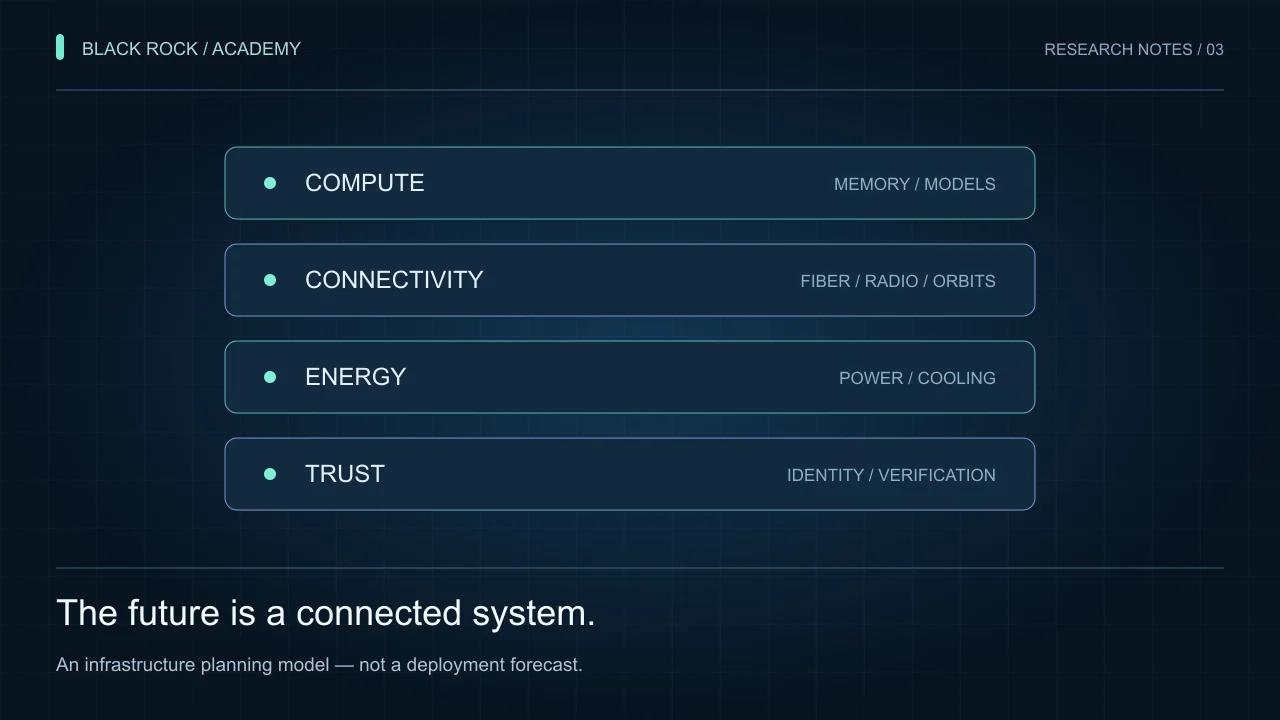
New technologies matter most when they help those decisions produce a service that people can use and afford.
From isolated products to whole systems
AI accelerators, optical links, cloud platforms and radio networks increasingly form one service chain. Its performance is limited by the slowest relevant resource: memory movement, interconnect, storage, power delivery, cooling or software coordination. A larger model or faster link helps only when it removes the actual bottleneck. Start future planning with workload traces and failure modes rather than a catalogue of fashionable products.
A useful objective is cost per successful, verified task at a defined latency and availability. It counts failed attempts, human review and idle infrastructure. That measure can favour a small specialized model over a larger general model, or a modest local server over unnecessary round trips to a distant cloud. These are design choices to validate, not universal rankings.
Telecom will connect terrestrial and non-terrestrial systems
Fiber remains a capacity foundation; radio provides mobility and flexible last-mile access; satellites extend reach and path diversity. Their convergence requires authentication, orchestration and sensible service continuity, not merely a shared brand. ITU's IMT-2030 work frames the development of 6G. It is not evidence that every proposed feature is commercially deployed. [1] Treat a '7G' sales claim as a request for a specific standard and demonstrated capability.
Choose edge placement from the application. A camera stream can be filtered locally before selected results move to the cloud; batch analysis may benefit from centralized resources. Data minimization can reduce transmission and privacy exposure, but local devices still need patching, access control and recovery. Distributed deployment adds operational complexity as well as potential latency benefits.
Energy is a design input
AI infrastructure cannot grow independently of electricity supply, grid connections and cooling. The IEA's Energy and AI report analyses this relationship through scenarios, not a guaranteed consumption trajectory. [2] For an individual project, ask whether sufficient power is actually deliverable, at what utilization and with what redundancy. Include cooling-system maintenance and water constraints where relevant.
An original accounting example clarifies scale: a constant 100 kW IT load with PUE 1.3 requires 130 kW of facility power, or approximately 1.139 GWh across 8,760 hours. That assumes constant load and constant PUE; it is not a measured ADNET facility. Scheduling, utilization and better cooling can change the total. PUE alone says nothing about the usefulness of the computation.
Trust must evolve with automation
More capable agents can help classify incidents, propose configuration changes and search logs. Give each workflow bounded permissions, independent checks and a reversible path. A fluent explanation is not proof that a network change is correct. Keep provenance for training and operational data, and measure error rates in the actual deployment context.
Cryptographic migration is a present engineering task even though the timing of a large cryptographically relevant quantum computer is uncertain. NIST finalized FIPS 203, 204 and 205 in 2024. [3] Inventory protocols, certificates and long-lived secrets; test supported migration paths and interoperability. Post-quantum algorithms do not repair stolen passwords, vulnerable endpoints or poor key management.
| Horizon | Priority | Evidence required |
|---|---|---|
| Now–2028 | Measure workloads; improve utilization, security and recovery | Production pilot, cost per verified task, failure tests |
| Around 2030 | Evaluate mature 6G and integrated edge/network services | Completed standards, local availability, business case |
| 2030s and beyond | More autonomous orchestration and distributed intelligence | Sustained reliability, governance and economic viability |
Use milestones instead of confident distant dates
The roadmap below is the author's planning framework, not a prediction model. Revisit it when standards, unit economics, measured reliability or customer requirements change.
Over the next few years, integration and operational quality can matter more than spectacular demonstrations. Longer-term possibilities, including more autonomous systems and richer sensing networks, remain conditional on reliability, governance and affordable deployment. Preserve modular interfaces and avoid irreversible dependence on one speculative outcome.
Sources
ADNET / Resilience & hybrid connectivity
A decision for regional networks
Türkiye's regional opportunity calls for coordination between connectivity, computing and energy plans. Treat each new standard or platform as a milestone to evaluate against local demand, operating capability and the cost of keeping the service available.
Explore solution ↗Adapted for ADNET from the author's Black Rock Academy essay. Original technical discussion and references are retained; the ADNET application note below adds the corridor-planning context.
Read the original essay ↗Share or cite this article
Hamid Reza Assariha. The next decade of technology: compute, connectivity and trust. ADNET, 2026-10-09. https://www.adnetinternet.com/insights/technology-next-decade-ai-telecom-infrastructure/